- One day, sunrise to moonrise
- Fourth day after the Kartik full moon
- Punjab, Haryana, Delhi, Rajasthan, UP
- About nine days before Diwali
Where it began
The name joins two words. A karva is a small clay pot with a spout, and chauth means the fourth day. The fast falls on the fourth day of the waning moon in the month of Kartik, and the clay pot is at the heart of the evening puja, filled with water and passed from hand to hand.
Legend says a young queen named Veeravati kept her first fast at her parents' home. Her seven brothers could not bear to see her hungry, so they lit a fire behind a tree and held up a sieve so the glow looked like the moon. She broke her fast too early and soon heard her husband had fallen gravely ill. She kept the fast again with full faith, and he was restored. Many families say this is why the moon is seen through a sieve today.
Another story tells of a wife named Karva, whose husband was caught by a crocodile while bathing. She tied the crocodile with cotton thread and asked Yama, the lord of death, to spare her husband. Moved by her courage, Yama let him live. In the Mahabharata tradition, one story says Draupadi kept the fast on the advice of Krishna while Arjuna was away, and the Pandavas came through their hard times.
Scholars offer gentle theories too. The fast falls at the start of the rabi season, when wheat is sown, and karvas were pots used to store wheat, so it may once have been a prayer for a good crop. Another idea is that women prayed for husbands away on long journeys or military campaigns to come home safely. The day also built friendships, as a new bride far from her parents found a sister for life among the women of her new village.
How it grew over time
Ancient times
Fasts for the welfare of the family, tied to the moon and the farming year, are kept across North India, and the clay karva pot becomes the sign of this day.
Medieval period
In Rajasthan and Punjab the fast is linked in folk memory with prayers for men away on long campaigns, and the Veeravati and Karva stories are told at evening gatherings.
Village tradition
Women meet in a circle at dusk to hear the katha and pass their thalis, and the baya, a gift basket of sweets, dry fruit and clothes, goes to the mother-in-law.
1990s
Popular Hindi films show the fast as a love story, with the moon, the sieve and a husband who quietly fasts too. The day becomes a big, glamorous occasion in cities and abroad.
Today
Mehendi stalls, moonrise times for every city and video calls with the moon keep the old custom alive, and many husbands now fast alongside their wives.
How it is celebrated in different places
Punjab and Haryana
Sargi before dawn is a loving gift from the mother-in-law, and women gather in the evening singing songs while they pass the thali seven times around the circle.
Rajasthan and Uttar Pradesh
The clay karva is filled and decorated, and in Uttar Pradesh a dish of sweets and savouries called baayna is offered and then given to the mother-in-law.
Andhra Pradesh and Telangana
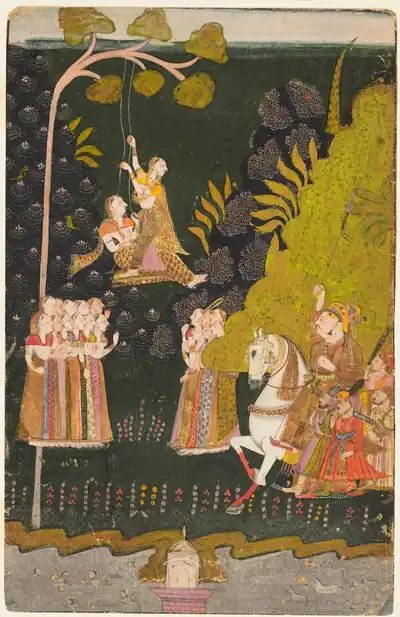
A related festival called Atla Taddi falls around the same time. Women and girls fast, swing on swings, play games and offer atlu, thin rice pancakes, before eating after moonrise.
Nepal
Families in the Terai plains, near the Indian border, keep the fast in the same way, waiting together on rooftops for the moon.
Fiji
Hindu families of Indian descent have kept Karva Chauth for generations, keeping the old katha and the evening puja close to home.
UK, US and Canada
Women gather in community halls and temples, book mehendi artists, share moonrise times in group chats and sometimes drive out of the city lights to see the moon clearly.
Karva Chauth moments
Karva Chauth today
The day begins in the dark with sargi: fruit, sweets, dry fruit and a little savoury food. Then comes a long day without food or water, softened by friends, mehendi, red and gold clothes and new bangles. In the evening the women sit together for the katha and the thali puja, then watch the sky.
When the moon rises, the wife looks at it through a sieve, offers water, and then looks at her husband the same way. He gives her the first sip of water and a bite of sweet to end the fast. More and more husbands keep the fast too, and many couples see it as a promise they make to each other every year.