TodayTools

About Durga Puja

00 days

About Durga Puja

Durga Puja celebrates Goddess Durga's homecoming and her victory over the buffalo demon Mahishasura. The main days run from Shashthi to Vijaya Dashami, the sixth to the tenth days of the bright half of Ashvin, in September or October.

The season begins on Mahalaya, when the Goddess is invoked. Families believe Maa Durga comes home to her parents with her children Lakshmi, Saraswati, Ganesha and Kartik, and leaves again on Dashami.

Neighbourhoods build pandals with clay idols and bright lights. People wear new clothes, go pandal hopping late into the night, offer anjali on Ashtami, share bhog, dance with the dhunuchi to the beat of the dhak, and play Sindoor Khela before the idol is immersed. Bijoya greetings, sweets and visits to elders follow.

It is the biggest festival of West Bengal, Tripura, Assam and Odisha and of Hindus in Bangladesh, and Bengali communities hold Pujas in Delhi, Mumbai, Bengaluru, London, New York, Toronto, Sydney and many other cities.

  • Main days Shashthi to Dashami
  • Month of Ashvin
  • West Bengal, Assam, Odisha, Tripura
  • UNESCO heritage since 2021

Where it began

Legend says the demon Mahishasura could not be defeated by any god, so the gods joined their powers to create Durga. Riding a lion and holding their weapons, she fought him for nine days and won on the tenth. Durga Puja celebrates this win of good over evil.

In Bengal the festival is also a homecoming. Durga is welcomed as a married daughter who comes back to her parents' home with her children, Lakshmi, Saraswati, Ganesha and Kartikeya, and leaves again on Vijaya Dashami.

One story tells that Rama worshipped Durga in autumn before his battle with Ravana, an early, out-of-season puja called akal bodhan. Records show wealthy landlord families of Bengal holding large home pujas by the 1500s and 1600s.

A pandal lit up with lights for the festival nights

How it grew over time

  1. Ancient times

    Durga's battle with Mahishasura is told in the Devi Mahatmya, a Sanskrit text recited during the festival to this day.

  2. 1500s to 1700s

    Landlord families in Bengal hold grand home pujas with music and feasts that the whole village joins.

  3. Late 1700s

    Rich families in Kolkata host famous pujas, and the festival becomes a big social event of the city.

  4. 1900s

    Neighbourhoods begin community pujas, called sarbojanin, paid for by everyone, and the pandal becomes a public space for all.

  5. 2021

    UNESCO adds Durga Puja in Kolkata to its list of the Intangible Cultural Heritage of Humanity.

  6. Today

    Theme pandals turn whole neighbourhoods into open-air art shows, and millions walk from pandal to pandal through the night.

How it is celebrated in different places

  • Kolkata, West Bengal

    Artists from Kumartuli shape the clay idols, and thousands of pandals light up the city for pandal-hopping, dhak drums and dhunuchi dance.

  • Assam and Tripura

    Durga Puja is the main autumn festival, with community pandals in every town and fairs in the villages.

  • Odisha

    Cuttack is known for silver and gold filigree decorations on its idols and pandals.

  • Bangladesh

    Durga Puja is the largest festival of the Hindu community, with many thousands of mandaps across the country.

  • UK, US and Australia

    Bengali associations hire halls for five days of puja, food stalls and cultural shows, often on the nearest weekend.

Durga Puja moments

The goddess with her famous wide, painted eyes
Idols dressed in saris in the potters workshop before the pujaKumartuli, Kolkata
Idols waiting for their final touchesKumartuli, Kolkata
A goddess taking shape in a clay workshopKumartuli, Kolkata

Durga Puja today

The festival opens with Mahalaya, when many families wake before dawn to hear the Mahishasura Mardini recitation. On Shashthi the goddess is unveiled, and the days that follow bring anjali prayers, bhog meals, new clothes, music and late nights with friends.

On Dashami married women smear vermilion on each other in sindoor khela, and the idols are carried to the river with drums and dancing. People hug, share sweets and say they will wait for the goddess to come back next year.

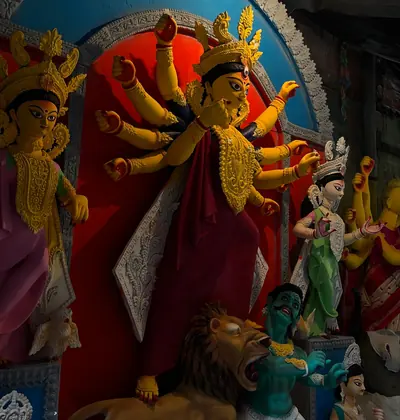
How people celebrate Durga Puja

  • Pandal hopping late into the night
  • Pushpanjali on Maha Ashtami
  • Sandhi Puja with 108 lamps and lotuses
  • Dhunuchi dance to the dhak drums
  • Khichuri bhog shared at the pandal
  • Sindoor Khela on Dashami
  • Bijoya visits, sweets and pranam to elders

How to wish well

  • Wish "Shubho Sharodiya" or "Shubho Durga Puja" during the festival, and "Shubho Bijoya" from Dashami onwards.
  • On Bijoya, younger people touch elders' feet or send a pranam; a respectful Bijoya message to elders is a kind gesture.
  • Odia friends say "Durga Puja ra shubhechha"; Assamese friends write Durga Puja with their own letters.
  • Light jokes about food and pandal queues are welcome; keep jokes away from the Goddess.
  • Mahalaya is solemn: wishes that day are prayers, not party messages.

Questions about Durga Puja

When is Durga Puja 2026?

Durga Puja 2026 begins on Maha Shashthi, 16 October, and ends with Vijaya Dashami about four days later. Kolkata almanacs can differ by a day, so check the date shown on this page.

When is Durga Puja 2027?

Durga Puja in 2027 is expected to begin around 5 October, with Dashami on 9 or 10 October.

What do you say on Durga Puja?

Say "Shubho Durga Puja" or "Shubho Sharodiya". After Dashami, say "Shubho Bijoya".

What is the difference between Durga Puja and Navratri?

They are the same season. Navratri honours the Goddess over nine nights across India; Durga Puja is how Bengal, Odisha, Assam and Tripura celebrate the last five days, with pandals and idols.

What is Sindoor Khela?

On Vijaya Dashami, married women offer sindoor to the Goddess and then smear it on each other's faces, wishing each other a long and happy married life.

What does Shubho Bijoya mean?

It means "happy victory". It is the greeting for Vijaya Dashami and the days after, when people visit elders and share sweets.

What are the main days of Durga Puja?

Maha Shashthi, Maha Saptami, Maha Ashtami, Maha Navami and Vijaya Dashami.

Keep exploring

Related

Coming up next

    All festival wishes

    Donate